
Laundry operators across the Philippines are moving decisively to capture the country’s rapidly expanding hotel laundry outsourcing demand, as intensifying competition and rising costs make neighborhood-based residential laundry increasingly challenging. This strategic shift is a central finding of The Philippine Laundry Outlook 2026, the country’s first dedicated industry outlook on the textile care sector.
Developed by Is It Clean, a consulting and training company for the laundry and cleaning industry, the report highlights how operators are realigning growth strategies toward institutional clients—particularly hotels—where scale, stability, and outsourcing economics are reshaping demand.
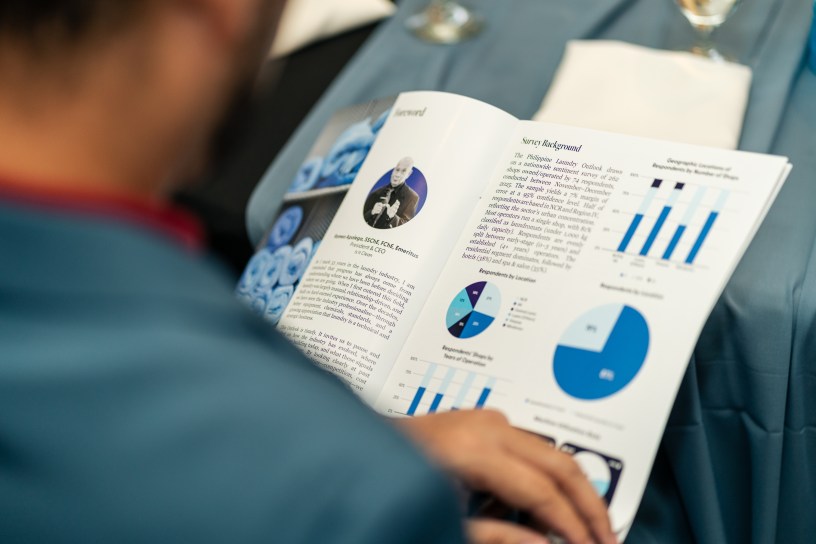
The Philippine Laundry Outlook 2026 is based on a sentiment survey conducted between November and December 2025 among 74 laundry operators owning a combined total of 262 laundry shops nationwide, representing a 7% margin of error at a 95% confidence level. Half of respondents are based in NCR and Region IV, most operate single-shop businesses, and over 80% are classified as laundromats with daily capacities below 1,000 kilograms.
Hotel outsourcing demand comes into focus
Is It Clean estimates that the Philippine hotel sector requires as much as 1.6 million kilos of linens processed daily, assuming full occupancy. A significant portion of this volume is now outsourced to industrial laundry operators as hotels seek to reduce capital expenditure, labor costs, and operational complexity.
Looking ahead, growth in hotel supply is set to further expand this demand. An estimated 3,100 new hotel rooms are expected to come online in Metro Manila in 2026, according to Colliers Philippines. Is It Clean says this translates to an additional 15,500 kilos of hotel laundry demand per day.
The report finds that 42% of respondents will focus on the hospitality sector in 2026, reflecting heightened interest for laundromats and operators to scale up and position themselves as outsourcing partners to the hospitality players, specifically smaller hotels and short-term rental.
Strong demand, but competition reshapes strategy
Beyond hotels, overall demand fundamentals remain strong. Nearly two-thirds (63%) of respondents reported higher laundry volumes in 2025, driven by continued urbanisation and the growing preference of Filipino households to outsource laundry. This provides a steady baseline demand for the industry.
However, competition is tightening, with more than 20,000 laundromats estimated to be operating across the Philippines. Lower to mid barriers to entry—supported by easier access to equipment financing—continue to attract new players, intensifying rivalry and compressing prices. In highly competitive NCR, the average wash-dry cycle cost (PHP 194.6) is already lower than in Region 4A (PHP 196.4). Despite this, sentiment remains cautiously optimistic, with 58% of respondents expressing a favorable outlook for the industry.
Scaling up means skilling up
As operators pursue hotel outsourcing contracts, growth constraints are shifting from demand to capability. Hotels impose higher standards around consistency, quality, and traceability—requirements that many operators are still building toward.
“This is no longer just about opening more shops or increasing capacity,” said Paolo Abellanosa, Managing Director of Is It Clean. “Operators must not just scale up, but they must also skill up. Without the right systems, trained people, and process discipline, chasing hotel volumes can increase risks rather than profits.”
Capital commitments amid structural pressures
To support this transition, 42% of respondents plan to invest in new equipment in 2026, signaling confidence in sustained demand and the need to upgrade for efficiency and scale. These capital commitments are closely tied to ambitions of serving hotels and other institutional clients more effectively.
“The outlook for the laundry sector remains positive, with 90% of operators saying industry performance in 2026 will either be stable or positive,” said Romeo Apolega, SSChE, FChE, Emeritus, President & CEO of Is It Clean. “Demand is there, especially from hotels, but the future of laundry will belong to those who learn continuously, innovate, retool, retrofit, reinvent, and invest in people and new processes.”
 Cleaning, Sanitation & Laundry